The Holy Vedas
The Vedas or Shruti:
believed to be the oldest texts in Hinduism even as a consensus is yet to be reached on how old they truly are. While there are some scholars who say that they were written about 2,500 years ago, many others believe that they were documented at the start of Kali-yuga (circa 3000 BCE).
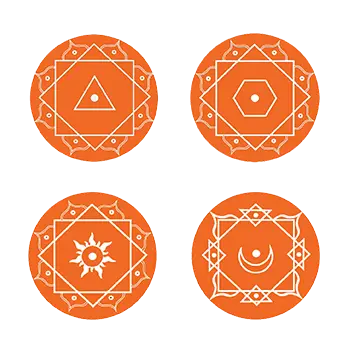
The Sri Chakra is central to Shakta worship, it is not a geometric diagram but a map of your inner consciousness. According to the Bhavana Upanishad, the Sri Chakra reflects the human body, each triangle, petal, and circle corresponds to a part of your energy system.
The Rig-Veda
Believed to be the oldest of the Vedas. Has ten mandals or books with 1028 hymns that praise “Vedic Gods” like Indra, Agni, Vishnu, Rudra, Varuna etc. Plus, it also has the famous Gayatri mantra and the Purusha Shukta (the story of Primal Man) prayer.
The Yajur-Veda
Sama-Veda
Atharva-Veda
Includes hymns, mantras and incantations which are beyond the scope of yajna. Each of these four Vedas are divided into Samhitas, Brahmanas, Aranyakas & Upanishads.
Vedas have two critical pieces of supplementary literature, related closely to the Vedas. They are:
Vedangas: sciences that help us understand and apply the Vedas.
- Kalpa (ritual detail)
- Siksha (pronunciation)
- Vyakarana (grammar)
- Nirukti (etymology)
- Chandas (metre)
- Jyotisha (astronomy/astrology)
Annant Drishti Aadhaytam Peetham is devoted to learning and spreading Ancient Indian
Wisdom contained in its multiple scriptures and philosophies far and wide.If you have the same interest, do get in touch.