Everyone knows the exoteric Dhanteras. You buy gold. You buy steel. You light a lamp for Lakshmi and hope wealth stays.
The esoteric Dhanteras is older, and it has almost nothing to do with shopping.
Its real name in the Agamas is not Dhana-Trayodashi. It is Amrita-Samudbhava Trayodashi — the thirteenth night when nectar rises to the surface.
Why health comes first
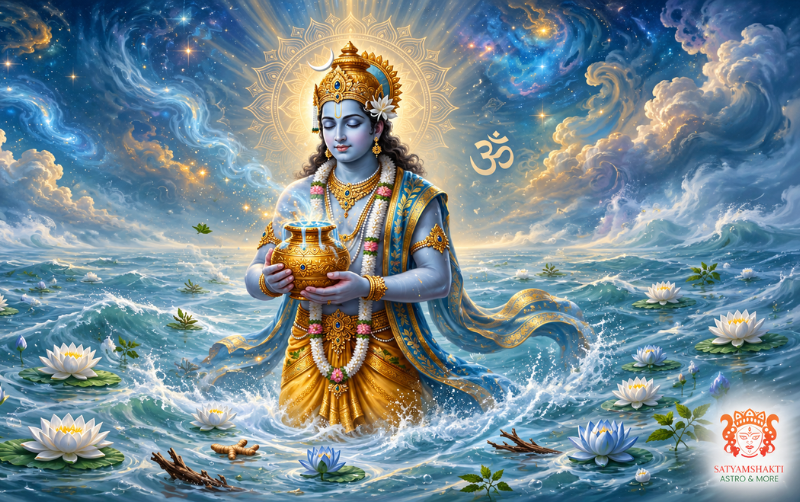
Dhanteras is officially Dhanvantari Jayanti, also marked as National Ayurveda Day. According to the Bhagavata Purana, on this tithi during Samudra Manthan, Lord Dhanvantari emerged from the ocean of milk holding a pot of amrit and the knowledge of Ayurveda.
He is not just the physician of the gods. He is described as an avatar of Vishnu himself, the principle that makes healing possible. In Tantra, the saying is simple: without a body that can hold it, wealth cannot stay. Dhan is not gold. Dhan is that which holds.
That is why three gods are worshipped on the same night — and esoterically, they are one circuit.
Lakshmi is expansion. The current that flows out, multiplies, brightens.
Kuber is contraction. The Yaksha who guards the North, the direction of stillness. He is the holder, the one who says “stay here.”
Dhanvantari is transmutation. He converts flow into tissue, into ojas, into years of life. His symbols are telling: in one hand the pot of nectar, in the other a leech. One gives immortal essence, the other sucks out what is impure.
Do Lakshmi-Kuber without Dhanvantari and you get wealth your body cannot enjoy. That is why the old tantric lineages began Diwali not with Lakshmi, but with Dhanvantari.
The ocean is inside you
The esoteric reading of Samudra Manthan is not a myth about an outside ocean.
The Mandara mountain is your spine. The serpent Vasuki is your breath, pulled left through Ida and right through Pingala. The churning is kumbhaka — breath retention. The first thing that comes out is always poison — suppressed disease, undigested emotions, ama. Only after that does the pot of amrit rise.
Trayodashi, the thirteenth lunar phase, is ruled by Kama in Tantra Shastra. It is the phase where desire itself can be transmuted. The veil is thin. That is why tantra considers this night potent — not for acquiring, but for purifying the vessel.
The water pot you keep in front of the deity on Dhanteras is not decoration. It is your outer kalasha mirroring the inner kalasha at the crown, from which, in subtle anatomy, nectar is said to drip down the central channel when the system is calm.
The Yantra is a map of your body
A true Dhanvantari Yantra is different from the Shree Yantra everyone prints.
At its center is a single point — the pot. Around it, eight petals. These are the eight branches of Ayurveda Tantra — surgery, eye and ENT, medicine, psychology and spirits, pediatrics, toxicology, rejuvenation, and vitality. Esoterically, they are your eight systems.
Around that, twelve petals for the twelve solar cycles that govern health through the year. And on the outermost ring, a circle of flames — the Sudarshana Chakra, the wheel of time that cuts disease before it takes root.
You are not supposed to just look at it. In the esoteric practice, you become the pot.
The real ritual
On the surface, people buy metal. Esoterically, you are anchoring a tattva. Gold is the metal of Tejas, steel is of Shani — stability. Bringing them home on Dhanteras is a way of saying to the subconscious: let abundance have a solid place to sit.
And you light Yam Deepa — a small lamp outside the house, facing South, for Yama, the lord of death. No other wealth festival invites death to the door. Dhanteras does. It whispers: remember you will die, so heal now. Health tantra without death-remembrance becomes ego. With it, it becomes sacred.
The esoteric sadhana done by Nath and Ayurvedic families from Dhanteras to Bhai Dooj is not loud. No incantations shouted. It is silent. Sit facing North in the evening twilight. Place a brass lota of water with Tulsi. Breathe thirteen slow breaths for Trayodashi. Visualize the dark ocean at your heart being churned, and a luminous figure emerging with a pot. Feel that pot tilt over you, and a single drop of thick, honey-like light fall down your spine, finding the places that hurt and burning them clean. Then drink that water.
They call it becoming Agada — free of poison.
We invite Lakshmi on Diwali. But on Dhanteras, we ask a more ancient question: are we healthy enough, clear enough, pure enough to keep her when she comes?
That is the tantra of Dhanteras.