

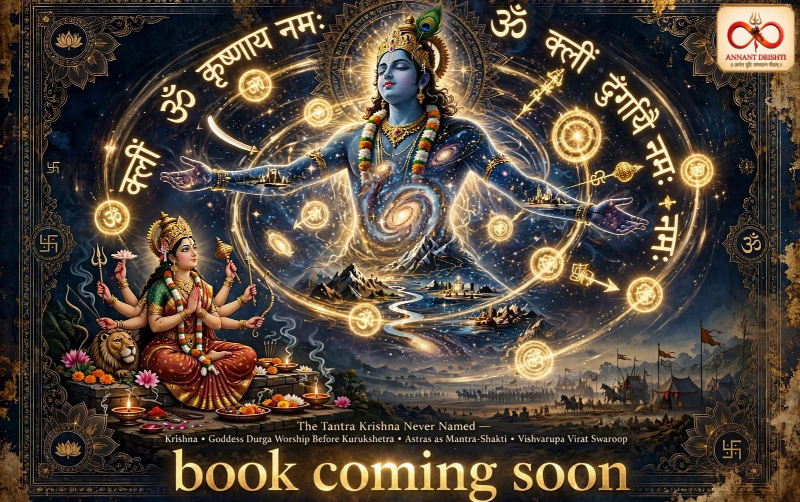
We read the Bhagavad Gita as philosophy. The Mahabharata treats it as initiation.
Before a single shloka of the Gita is spoken, Krishna does something most commentaries skip. Seeing the Kaurava army arrayed, he tells Arjuna to purify himself and compose a hymn to Durga for victory. Arjuna steps down from the chariot and invokes her with folded hands. The episode sits in Bhishma Parva, Section 23: before the Kurukshetra war, Arjuna worshipped Durga on Krishna’s advice for blessings.
In itihasa, shakti is not assumed. It is invoked. Krishna does not give Arjuna confidence. He gives him access. Durga is the threshold deity of battle, the one who turns fear into clarity. When the field becomes existential, the warrior first bows to the power that moves through the field.
Astras Were Mantras, Not Metal
An astra had to be received, not made. It came through a guru, it was awakened with precise shabda, and it had a samhara mantra to withdraw it. If the inner state was impure, it failed. That is mantra-vidya, not metallurgy.
Gandiva is a shakti-siddha instrument, potent because Arjuna’s tapasya made him an adhikari for it. Hanuman on the dhvaja is a living presence, stabilizing prana in chaos. Karna’s kavacha is Surya’s tejas condensed.
The Gita as Initiation
Krishna prepares the vessel before pouring the vision. He diagnoses Arjuna’s vishada as a mala, a covering, not a logical error. He teaches in stages, karma to bhakti to jnana, as one leads a shishya inward. When words reach their limit, he gives divya-chakshu, the eye to see.
That is why the eleventh chapter is called Vishvarupa Darshana Yoga, known also as Virat Swaroop. Darshana here is not theory. It is direct, terrifying perception.
Aham Brahmasmi Made Visible
Arjuna does not hear Aham Brahmasmi. He sees it. The Vishvarupa shows countless mouths, eyes, worlds, births and deaths, all arising in one body. Arjuna trembles because nonduality is not peaceful when first seen.
Through Kashmir Shaivism: Akula and Kula
Akula and Kula are two aspects of the Supreme Reality. Akula refers to Eternal Being and Kula to Eternal Becoming. In technical terms, whatever is kula is Shakti, and whatever is akula is Shiva, beyond the groups of manifestation. An Akulacharya is one rooted in Akula who can wield Kula without being bound by it.
That is Krishna in Kurukshetra. He stands in the formless, acts fiercely in form, invokes Durga, wields astras as mantra, and reveals all forms as his own play. Transcendence does not cancel power. It authorizes it.
Perhaps we missed the tantra of the Gita because we looked for rituals. It was there as method: invoke shakti before action, receive power only through purity, and let vision complete what argument cannot.
Www.annantdrishti.com- an upcoming spiritual Institute
[…] Sat Chit Ananda is not a prize for the few. In Vedanta it is the substrate of being, existence, consciousness, bliss. The question is not whether you are made of it, but what your soul took birth to do with it. […]
[…] Swami Vivekananda mentioned about Medha Nadi, that appeared with Brahmacharya. But is it applicable to women who are biologically different from men? The traditions could themselves never resolve this particular perspective. […]