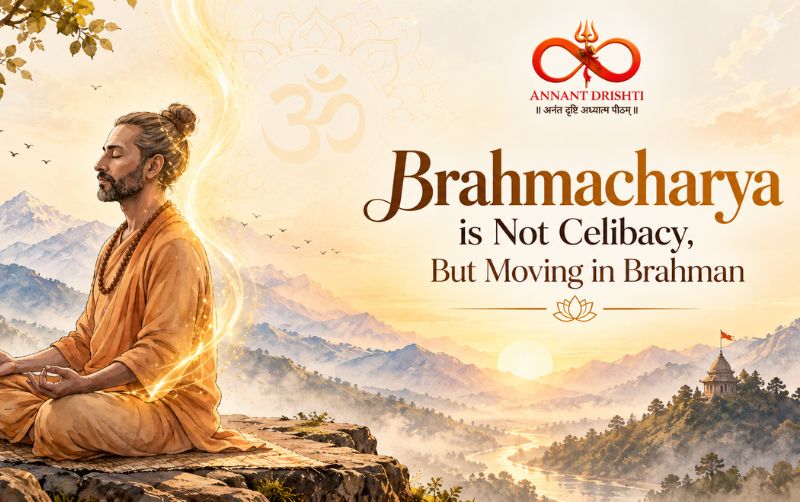
Brahmacharya is widely reduced to “no sex.” The word itself says more: brahmani charati — to move, to conduct oneself, in Brahman.
It was never just a bodily rule. It is a state of consciousness.
“What Shastra Says: Conserve to Awaken”
In the Vedic system, Brahmacharya was the first ashrama — the student’s life of study, discipline, and energy conservation.
Patanjali makes it the fourth Yama: brahmacharya pratishthayam virya labhah (Yoga Sutra 2.38) — on being established in Brahmacharya, vitality is gained. The commentaries are clear: this means restraint in thought, word, and deed, not mere physical abstinence.
For householders, Smritis prescribed moderation and fidelity, not absolute celibacy. The Chandogya Upanishad (8.5) gives the highest definition: only a mind not scattered outward can attain the world of Brahman.
Shastra’s essence: Don’t dissipate your vital energy. Turn it inward.
What Tantra Says: Transmute, Don’t Repress
Tantra accepts the goal but refines the method. Repressed desire, it warns, becomes distortion. Mastered desire becomes power.
Its ideal is the Urdhvaretas — one who draws retas (vital seed) upward through sushumna via pranayama, bandha, and mantra, converting it into ojas, spiritual radiance.
Hence in Kaula Tantra, even sacred union (maithuna) can be Brahmacharya if there is no unconscious loss, the partner is seen as Shiva/Shakti, and the mind stays absorbed in the Divine.
As the Kularnava Tantra implies: a celibate lost in fantasy is not a brahmachari; one free of craving, even in union, is!
……Tantra’s essence: Don’t just control energy. Redirect it upward…….
The Real Test:
Both traditions agree on one experiential check:
If after indulgence you feel drained, dull, and more bound — that was a-brahmacharya.
If you feel clear, energized, and freer — that was brahmacharya, whatever the outer form.
Brahmacharya is not the absence of sexuality. It is the absence of compulsiveness, and the presence of awareness.
In an age of constant stimulation, reclaiming it doesn’t mean renunciation. It means choosing where your attention flows — so the energy you save becomes the light by which you see.