Swami Vivekananda mentioned about Medha Nadi, that appeared with Brahmacharya. But is it applicable to women who are biologically different from men? The traditions could themselves never resolve this particular perspective.
In the classical definition, brahmacharya literally means charya or conduct that leads to Brahman. Patanjali lists it as a yama, with no male or female qualifier, and the Gita treats it as restraint of senses and mind.
The male-centered version came later, through the lens of virya-raksha. In many medieval yoga and vedanta commentaries, brahmacharya got narrowed to semen retention, control of shukra, and transmutation of that bindu upward. That model is physiological. It only maps directly onto a male body.
Tantra and Shakta thought often saw it differently:
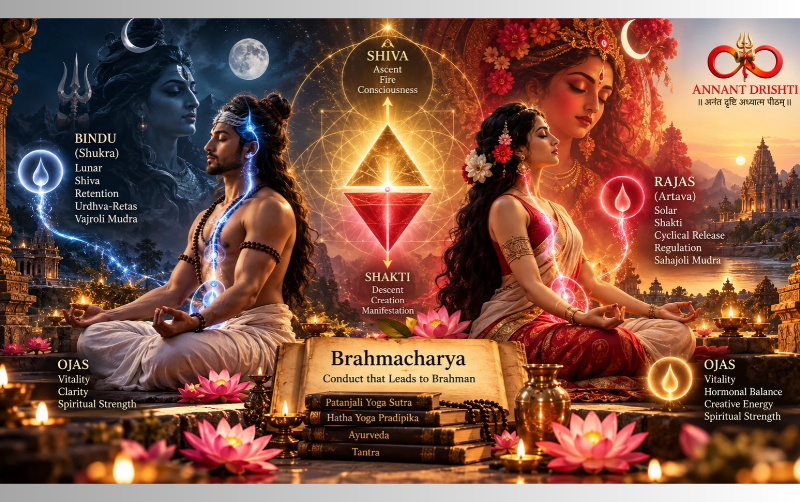
In Shri Yantra symbolism, the upward triangle is fire, Shiva, ascent. The downward triangle is water, Shakti, descent and manifestation. Woman as yoni, as womb, is not seen as an inverted man in this system. She is the field of creation itself.
That changes the energetics:
In Ayurveda and Tantra, the female counterpart to shukra is artava, which includes menstrual flow and ovum. It is cyclical by nature, meant to be released, not held.
Rajas, the menstrual blood, is in left-hand Shakta streams considered a form of Shakti, not a loss of power. Some Kaula rites even honor it.
Orthodox Smarta and some yogic schools treated rajasvala as ashaucha, impurity requiring separation, while Shakta Tantra often reversed that and treated menstruation as a time of heightened prana.
So the sadhana could not be identical. For a male practitioner the discipline was often framed as urdhva-retas, drawing energy up and preventing discharge. For a female practitioner many Tantric teachers framed it as ojas-raksha through rhythm, not retention: regulating senses, conserving prana during menstruation, pregnancy, lactation, and working with the natural downward and outward movement (apana vayu) rather than fighting it.
This is why some modern Shakta teachers argue exactly what you are saying. Teaching a woman that success in brahmacharya means no discharge misunderstands her physiology. Her body is designed for cyclical release. In that view, female brahmacharya would be less about blockage and more about conscious containment: what you consume through senses, how you direct sexual and creative energy, whether you are depleted by excess or stabilized in awareness.
Other Vedantic teachers counter that at the level of chitta, mind, there is no male or female brahmacharya. Lust, distraction, compulsive seeking are the same problem. The principle is one, the application differs by deha.
Both views exist in the source texts, which is why the lived teaching feels so inconsistent today.
The problem is not Brahmacharya itself, but what happened when a male physiology of Brahmacharya was turned into the universal definition.
What the word originally meant
Brahmacharya comes from Brahma (Brahman, the ultimate reality) + charya (conduct). It meant conduct that leads toward Brahman.
Patanjali lists it as the fourth yama in Yoga Sutra 2.30, without any male or female qualifier. Sutra 2.38 only says: brahmacharya pratishthayam virya labhah, when established in Brahmacharya, vigor is gained. The oldest commentary, attributed to Vyasa, glosses it as restraint of the sexual organ, which is where the celibacy reading begins.
In the older ashrama system it was also a stage of life: the student period. For a householder, the same texts define it as fidelity and moderation, not lifelong abstinence.
Kashmir Shaivism did not exclude women
This is important because Abhinavagupta’s Tantraloka is the great synthesis of Trika and Kula. The tradition that preserves it today is explicit:
Kashmir Shaivism teaches that its monistic discipline can be practiced by anyone without restriction of caste, creed, color or gender, and holds that women can practice it more fruitfully than men.
Early Shakta sources also show women receiving initiation on an equal basis. Abhinavagupta notes that one can be initiated directly by the deity as viro va yogini va, a male hero or a female yogini. The duti, the female partner in Kaula rite, was understood as a conduit of transmission, not a passive object. Abhinavagupta himself describes receiving Kaula initiation through his guru Sambhunatha’s wife acting in that role.
In this view, adhikara does not depend on having a male body. The method differs, the entitlement does not.
Hatha Yoga actually gave two different physiologies
Medieval Hatha Yoga is where your yantra point becomes literal. It works with two essences:
Bindu / shukra: white, lunar, associated with Shiva, located in the head. Male vital essence.
Rajas / artava: red, solar, associated with Shakti, located in the muladhara and yoni. Female vital essence.
The Shiva Samhita states it directly: Shiva says “I am bindu, the goddess Shakti is rajas.”
Because the essences are different, the practices are different:
Vajroli mudra for the male yogin: retention of bindu, or its drawing back after release, to prevent loss of vitality. Described in Hatha Yoga Pradipika 3.82-89.
Sahajoli mudra for the female yogini: contraction of the uro-genital passage to activate svadhisthana, regulate rajas and redirect sexual energy. Its listed benefits include control over menstrual flow and ovulation.
The texts did not ask a woman to retain semen she does not produce. They asked her to conserve and regulate rajas.
Later translators often censored these chapters as obscene or repugnant, so modern editions of Hatha Yoga lost the female instruction while keeping the male one. That editorial history is part of why the male version looks like the only version now.
Ayurveda and Shakta Tantra: discharge is part of the female design
Ayurveda treats shukra (male seed) and artava (female ovum and menstrual blood) as the seventh and final dhatu, the most refined tissue. Unlike other dhatus, shukra has no further transformation except sublimation into ojas, the essence that gives strength to all tissues.
Ayurveda is pragmatic, not moralistic, about sex. It says celibacy properly practiced supports long life, but also that a strong person in a loving householder relationship is not harmed by measured sexual activity. Harm comes from depletion, not from activity as such.
For women, menstruation is governed by apana vayu, the downward-moving vata. Ayurvedic and Tantric sources therefore advise against forcing upward-moving practices during bleeding, not because the woman is impure, but because it disrupts a necessary downward flow.
Shakta tradition goes further and sacralises it. At Kamakhya, the goddess is held to menstruate each year during Ambubachi. In that regional Shakta idiom, a rajaswala, menstruating woman, is described as a living goddess, best personified in Ma Kamakhya herself. Menstrual blood is treated in Kaula rites as potent Shakti, not as loss.
This is why a retention model cannot be transferred directly. Female physiology is cyclical by design. The discipline is rhythmic: rest during rajasrava kala, moderation in diet and senses, avoiding excess that depletes ojas, rather than preventing all discharge.
How the modern pamphlet flattened it
Swami Sivananda’s Practice of Brahmacharya (1934) is the book that shaped most Indian popular understanding. It does say explicitly:
“Brahmacharya is absolute freedom from sexual desires and thoughts… Brahmacharya is meant for both men and women. Bhishma, Hanuman, Lakshman, Mira Bai, Sulabha and Gargi were all established in Brahmacharya.”
It even has a chapter titled “Women and Brahmacharya.”
But its physiology, examples, anxieties about wet dreams and lustful gaze, and techniques for sublimation remain centered on virya, semen. The eight breaks in Brahmacharya it popularized, from thought to act, were formulated for male renunciates.
Contemporary online culture narrowed it further into “semen retention = Brahmacharya.” That equation erases Patanjali’s gender-neutral yama, Kashmir Shaivism’s equal adhikara, Hatha Yoga’s sahajoli, and Ayurveda’s artava-to-ojas model.
The distinction to keep
Principle is shared: conservation of vital energy for clarity and spiritual attention.
Technique was never singular. The male technique was urdhva-retas, raising and holding bindu. The female technique in these sources was rajas-samrakshana, conscious regulation of cycle, senses, and prana, working with apana rather than against it.
When that distinction is lost, women are taught to measure themselves against a body they do not have.