For a couple longing to welcome a child, difficulty in conceiving can become much more than a physical concern. It can affect emotions, relationships, hope and even one’s spiritual confidence.
Sanatana Dharma offers an ancient perspective on this deeply personal journey. However, it is important to understand that the Vedas do not describe “infertility” as a modern medical diagnosis with today’s categories, tests and clinical definitions. Instead, Vedic hymns concerned with fertility speak through the language of conception, obstacles, restoration, nourishment, prayer and divine assistance.
This distinction makes the Vedic approach especially meaningful.
Rather than defining a couple entirely by the problem, the prayers focus on removing what prevents conception and creating favourable conditions for new life to take birth.
One of the clearest examples occurs in Atharva Veda 3.23, a hymn associated with fecundity and conception.
Its opening verse addresses a condition preventing a woman from bearing a child and asks that its cause be made to disappear and be placed far away. The following verses pray for conception and for a garbha to become established in the womb.
This is significant.
What it does reveal is a spiritual worldview in which difficulty conceiving was not necessarily regarded as an irreversible destiny. The obstruction could be prayed over, addressed and sought to be overcome.
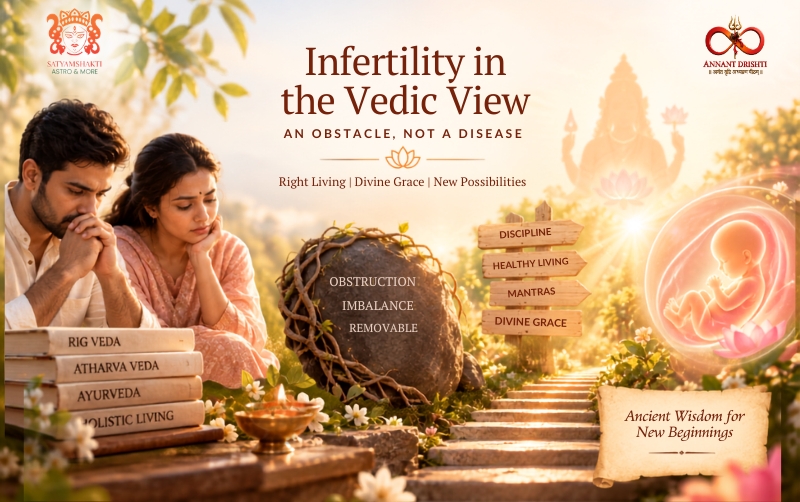
That offers a very different emotional message that An obstacle is not the same thing as an ending.
The Rig Veda 10.184 gives us another extraordinary window into the Vedic understanding of conception.
Rather than invoking only one deity, the hymn calls upon several divine powers like Vishnu to prepare the womb, Tvashta to shape the form, Prajapati to participate in generation, Dhata to establish the embryo, and Sinivali, Saraswati and the Ashvins in relation to conception and the Garbha.
The spiritual message is beautiful. Conception is represented not as one isolated event but as something requiring the right conditions, right establishment, nourishment and divine grace.
This provides an important foundation for understanding fertility within the wider philosophy of Garbh Sanskar.
Ayurveda developed sophisticated ways of understanding reproductive health through factors such as Dosha, Dhatu, Artava, Shukra and bodily channels.
Vedic prayer emphasises removing impediments and invoking fertility, while Ayurveda later provides more systematic theories of physiological balance and reproductive health.
Together, they contributed to a broader Indian tradition in which fertility was approached through body, conduct, environment, ritual and spirituality.
One misconception should also be removed that difficulty conceiving should never automatically be treated as a woman’s problem.
This also fits beautifully with our earlier discussion of Garbh Sanskar. Before attempting to nurture the Garbha, both prospective parents can prepare themselves through responsible healthcare, healthier routines, emotional harmony, spiritual discipline and Sankalpa.
The goal is not to ask, “Who is responsible?”
The better question is: “How can we prepare together for the possibility of welcoming new life?”
Rig Veda 10.184 demonstrates that conception itself was worthy of sacred invocation. Atharva Veda 3.23 similarly contains prayers seeking the removal of impediments and the establishment of pregnancy.
A knowledgeable practitioner may therefore guide a couple towards suitable puja, mantra-japa, Sankalpa, Ishta Devata worship or traditional Samskara, according to their spiritual tradition.
Choosing medical fertility care does not mean abandoning Dharma. If conception is delayed, seeking evaluation from a qualified gynaecologist, reproductive medicine specialist or fertility specialist can help identify possible medical causes. Depending upon the circumstances, contemporary treatment may involve lifestyle changes, medicines, surgery, assisted reproductive technologies or other clinically appropriate options.
Alongside this, a couple who follows Sanatana Dharma may continue their prayers, mantras and spiritual practices. Medicine can investigate the body. Spiritual practice can support the inner journey. They need not be enemies.
This distinction is especially important when marketing Garbh Sanskar or spiritual fertility services. Couples experiencing infertility are often emotionally vulnerable. They deserve guidance that gives them hope without making promises that cannot responsibly be made.
Perhaps the most empowering lesson we can draw from these ancient hymns is that they do not make the desire for a child insignificant.
They pray for it. They acknowledge the obstacle. And then they turn towards preparation, invocation and hope. That can transform the fertility journey.
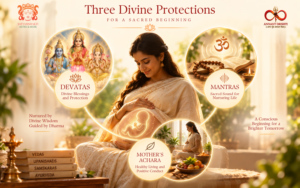
Instead of approaching Garbh Sanskar only after pregnancy has already begun, couples can begin earlier with Sankalpa, responsible health preparation, sattvic living, harmonious relationships, appropriate mantra and prayer, and the grace of their chosen Devata.
The ancient prayer does not guarantee the outcome. It teaches something subtler:
Where there is an obstacle, seek the right understanding. Where something can be corrected, act responsibly. Where human control ends, leave space for grace.
Couples seeking personalised Garbh Sanskar guidance, pregnancy mantras, Vedic prenatal Samskaras or spiritually appropriate practices during pregnancy Connect with me on WhatsApp +91 750 707 5962