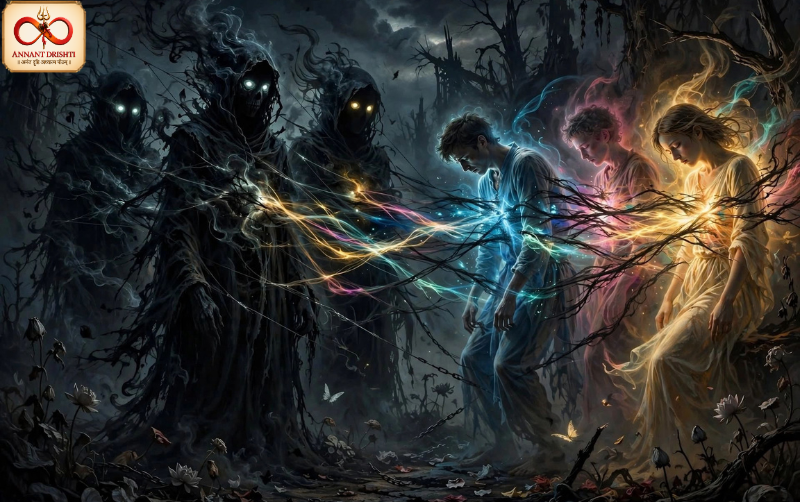
There is a quiet, unspoken tragedy unfolding across the modern spiritual marketplace and performative culture: the rise of spiritual vampirism. We live in an era where thousands of years of sacred philosophy can be packaged into a 15-second reel, stamped with a heavy Sanskrit mantra, and presented as realization. But beneath the polished aesthetics and effortless posturing lies a stark reality, some people do not generate their own light. They borrow it. They stand close to those who have endured real friction, real grief, and real tapas and they siphon.
To understand why this happens and how to protect your own inner life we have to look at what is actually being traded, what is being lost, and why becoming human is the hardest gate of all.
Borrowed Heat and the Hunger of Name
Real work is unglamorous. Authentic sadhana (spiritual practice) involves sitting with your own darkness, taking accountability for your messes, and enduring the uncomfortable heat of transformation. It builds a genuine inner spine.
When someone lacks the willingness to do that work, but still craves the visibility, authority, or applause that comes with it, a dangerous trade occurs. They begin looking for external sources of heat. They trade in:
Borrowed Stories: Adopting other people’s revelations and presenting them as firsthand experience.
Manufactured Drama: Creating friction or controversies that force people to react—because that reaction is the attention-currency they need to feel alive.
Siphoned Energy: Leaning heavily on the presence, credibility, or grief of others to give themselves weight.
Fame and visibility are insatiable. They require constant feeding. When a person relies on external validation to validate their existence, they eventually have to sell the one safeguard that keeps them grounded: their Vivek (discernment).
Selling Your Vivek: The Compass for a Flare
Vivek is the capacity to discriminate between the real and the unreal, the essential and the transient, what is truly yours and what you have stolen. When you trade your Vivek for immediate visibility, you throw away your inner compass for a flare. The flare lights up the room dramatically for a moment, but it burns your hands and leaves you completely blind in the dark once it dies down.
Without Vivek, a person loses the ability to distinguish between genuine realization and performative ego. They fall into a trap of continuous performance. Because there is no internal substance to stand on when the cameras turn off, they cannot stop performing. If they stop, the void catches up. This is why such people often appear exhausted, restless, and drained, even while shining brightly on the outside.
The Distortion of “Aham Brahmasmi”
Perhaps the most glaring symptom of lost Vivek is how non-dual philosophy gets twisted to serve the inflated ego. In the classical Upanishadic tradition, the mahavakya Aham Brahmasmi (“I am Brahman” / “I am the Divine Consciousness”) is not an entry-level flex. It comes only after long, grueling preparation through Vivek, Vairagya (dispassion), and deep contemplation. It is the moment where the personal ego completely dissolves into the universal.
The true implication of Aham Brahmasmi is radical equality and responsibility:
If I am Brahman, then so are you. So is the animal, the stranger, and the person whose energy I am tempted to exploit. How can I steal from or harm another without doing it to myself?
When the ego adopts this philosophy without doing the work, it flips the meaning entirely:
“I am Brahman, therefore my hunger is divine, my exploitation is just ‘leela’ (play), and my urge for fame is a sacred mission.”
This distortion is spiritual egoism at its most toxic. It takes a truth meant to extinguish self-importance and turns it into a license for unchecked narcissism.
The Gate of Kali: Becoming Human First
In the wisdom traditions of the Devi (the Divine Mother), one cannot simply jump to Tripura Sundari the embodiment of ultimate beauty, harmony, grace, and spiritual accomplishment—without first passing through the gates of Kali and Dhumavati.
Maa Dhumavati represents the uncomfortable truths: loss, decay, disappointment, and the unvarnished reality of existence.
Maa Kali demands absolute truthfulness and the death of self-deception. Kali’s first test is never whether you can recite high philosophy or wield spiritual terminology. Her test is: Have you become human yet?
Becoming human is vastly harder than posturing as a god.
Becoming human means keeping your word when it costs you something.
It means feeling genuine remorse when you hurt someone and having the courage to ask for forgiveness.
It means cleaning up your own emotional and physical messes rather than leaving them for others.
It means sitting quietly in the dark with your own pain without snatching someone else’s torch to light your way.
Even in traditional narratives, the avatars who represent the Divine show their divinity not by floating above human experience, but by entering into it fully. Lord Ram grieves openly when Sita is taken; Lord Krishna washes the dust from his friends’ feet and feels the heavy weight of war. Their divinity shines through their profound, uncompromising humanity not through an immunity to it.
Those who try to leap straight to authority and grace without passing Kali fail the gate. They take the words, the robes, and the aesthetic, but leave behind the ground of integrity that can actually hold them.
How to Protect Your Light
When you encounter people operating this way, the exhaustion you feel around them is real. It is the natural physiological and subtle reaction to being near a void that constantly requires outside energy to sustain itself.
Your response to this requires clarity and precision:
Guard Your Vivek: Keep your discernment sharp. Recognize the difference between someone who speaks from lived experience and someone who speaks from a polished script.
Practice Maun (Silence): Do not engage in unnecessary debates or public call-outs. Drama and outrage are just another form of energy for a hungry ego. Silence starves the dynamic naturally.
Keep Your Distance: You do not owe your presence, attention, or reaction to everyone who demands it.
Keep Your Work Clean: Focus on your own ground, your own responsibilities, and your own quiet practices.
Let others chase the crown, the title, or the audience. Focus instead on building the spine. The name can be built or bought again in a hundred different ways but once you lose your Vivek, buying it back takes a lifetime.
Brahmacharya is widely reduced to “no sex.” The word itself says more: brahmani charati — to move, to conduct oneself, in Brahman.
It was never just a bodily rule. It is a state of consciousness.
“What Shastra Says: Conserve to Awaken”
In the Vedic system, Brahmacharya was the first ashrama — the student’s life of study, discipline, and energy conservation.
Patanjali makes it the fourth Yama: brahmacharya pratishthayam virya labhah (Yoga Sutra 2.38) — on being established in Brahmacharya, vitality is gained. The commentaries are clear: this means restraint in thought, word, and deed, not mere physical abstinence.
For householders, Smritis prescribed moderation and fidelity, not absolute celibacy. The Chandogya Upanishad (8.5) gives the highest definition: only a mind not scattered outward can attain the world of Brahman.
Shastra’s essence: Don’t dissipate your vital energy. Turn it inward.
What Tantra Says: Transmute, Don’t Repress
Tantra accepts the goal but refines the method. Repressed desire, it warns, becomes distortion. Mastered desire becomes power.
Its ideal is the Urdhvaretas — one who draws retas (vital seed) upward through sushumna via pranayama, bandha, and mantra, converting it into ojas, spiritual radiance.
Hence in Kaula Tantra, even sacred union (maithuna) can be Brahmacharya if there is no unconscious loss, the partner is seen as Shiva/Shakti, and the mind stays absorbed in the Divine.
As the Kularnava Tantra implies: a celibate lost in fantasy is not a brahmachari; one free of craving, even in union, is!
……Tantra’s essence: Don’t just control energy. Redirect it upward…….
The Real Test:
Both traditions agree on one experiential check:
If after indulgence you feel drained, dull, and more bound — that was a-brahmacharya.
If you feel clear, energized, and freer — that was brahmacharya, whatever the outer form.
Brahmacharya is not the absence of sexuality. It is the absence of compulsiveness, and the presence of awareness.
In an age of constant stimulation, reclaiming it doesn’t mean renunciation. It means choosing where your attention flows — so the energy you save becomes the light by which you see.

[…] It was never just a bodily rule. It is a state of consciousness. […]
[…] The CompleteProtectors of Shree Vidya: […]